Plumerai VLM Text Search API
This document describes the API for the Video and Text Matcher functionality.
These components are part of Plumerai Video Search and Plumerai Real-time Alerts. See those product pages for architectural context and real-world usage examples.
For reference, the architecture diagram below shows how the text embedder and matcher fit into the overall system:
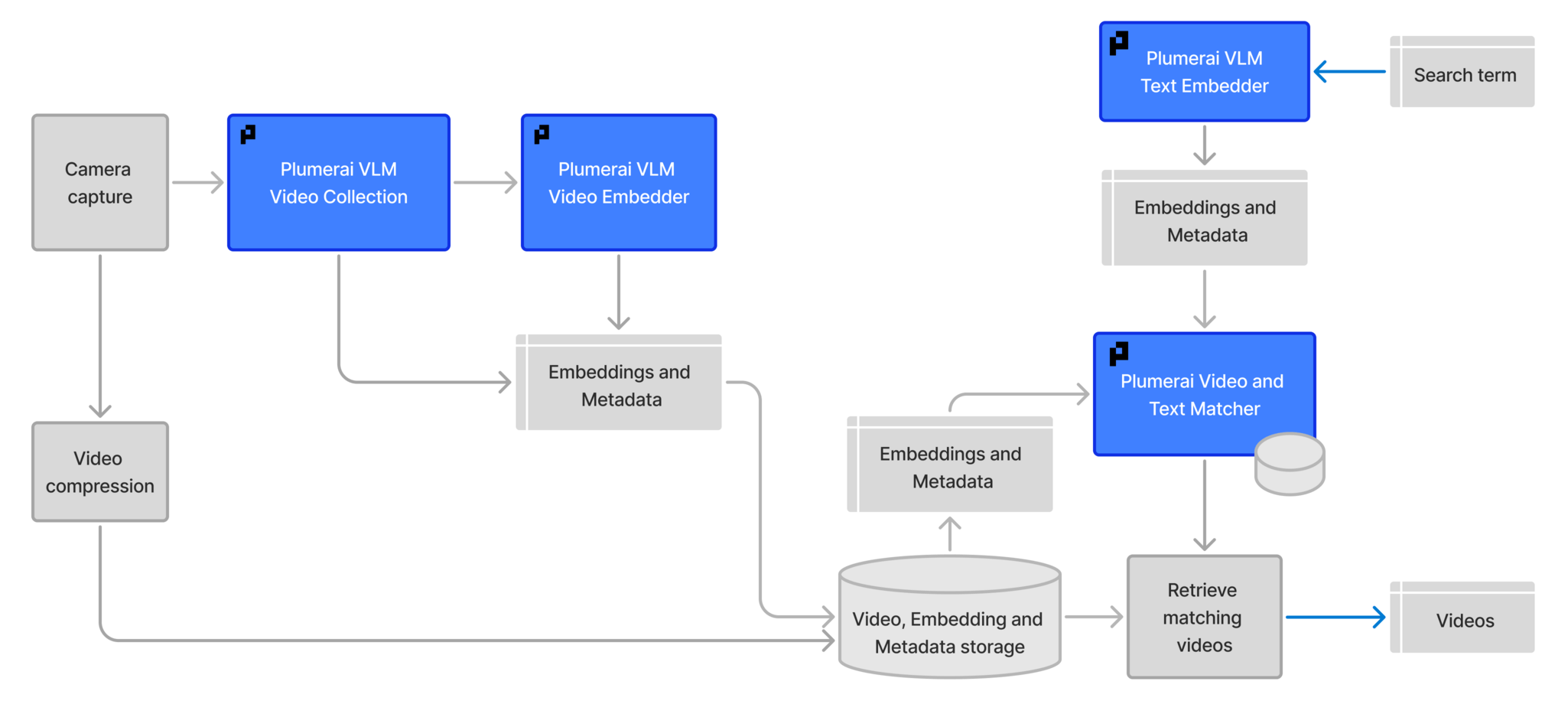
For the VLM Video Collection and VLM Video Embedder API documentation, visit this page.
Creating text encodings can be done using the Python API encode_text. The resulting binary blob can then be used in the search C++ function.
vlm_text_search
search
ErrorCode
search(const std::vector<std::tuple<const std::uint8_t*, std::size_t>>&
           user_history,
       std::tuple<const std::uint8_t*, std::size_t> text_embedding,
       std::vector<ScoreResult>& search_results);
Search a user's history for relevance to a given query string.
The text embedding is expected to be generated using the plumerai_vision_language package.
The results are returned in the same order as the user_history input, i.e. the first ScoreResult corresponds to the first video embedding in user_history.
Arguments:
- user_history: Vector of tuples with pointers and sizes of video embeddings.
- text_embedding: Tuple with a pointer and size of the text embedding.
- search_results: Vector to store the search results.
Returns:
- Returns
INVALID_VIDEO_EMBEDDINGorINVALID_TEXT_EMBEDDINGon error, otherwiseSUCCESS.
Example:
// Assume a text embedding is stored in `text_embedding`
std::vector<std::uint8_t> text_embedding;
// Create a list of videos to search through
std::vector<std::tuple<const std::uint8_t*, std::size_t>> user_history;
// Video embedding obtained from plumerai::VLMVideoEmbedder
user_history.emplace_back(clip_embedding_ptr, clip_embedding_size);

std::vector<plumerai::vlm_text_search::ScoreResult> search_results;
const auto error_code = plumerai::vlm_text_search::search(
    user_history, {text_embedding.data(), text_embedding.size()},
    search_results);
if (error_code != plumerai::ErrorCode::SUCCESS) {
  printf("Error: %s\n", plumerai::error_code_string(error_code));
}
IsMatch
Represents whether a video and search query match.
Allowed values:
YES: Video matches query.NO: Video does not match query.MAYBE: Video may match query but is uncertain.
SearchResultMetadata
Metadata as used in the ScoreResult objects.
ScoreResult
Result of a search query.
A higher similarity means the corresponding video is more relevant, and is_match indicates whether each result meets the match threshold.
The metadata.time field contains the time (in seconds) of the relevant part of the video for a search query. This is useful for displaying search results to users as the thumbnail can then be relevant for what they are looking for.